












What is an AI marketing department? The 7-seat model we run on
 StackBooster growth team 6 min read
Most "AI marketing" setups are a pile of tools. Someone opens a writing tool, then an image tool, then a scheduler, and copies text between them. Nothing remembers last week, and nobody owns the handoffs.
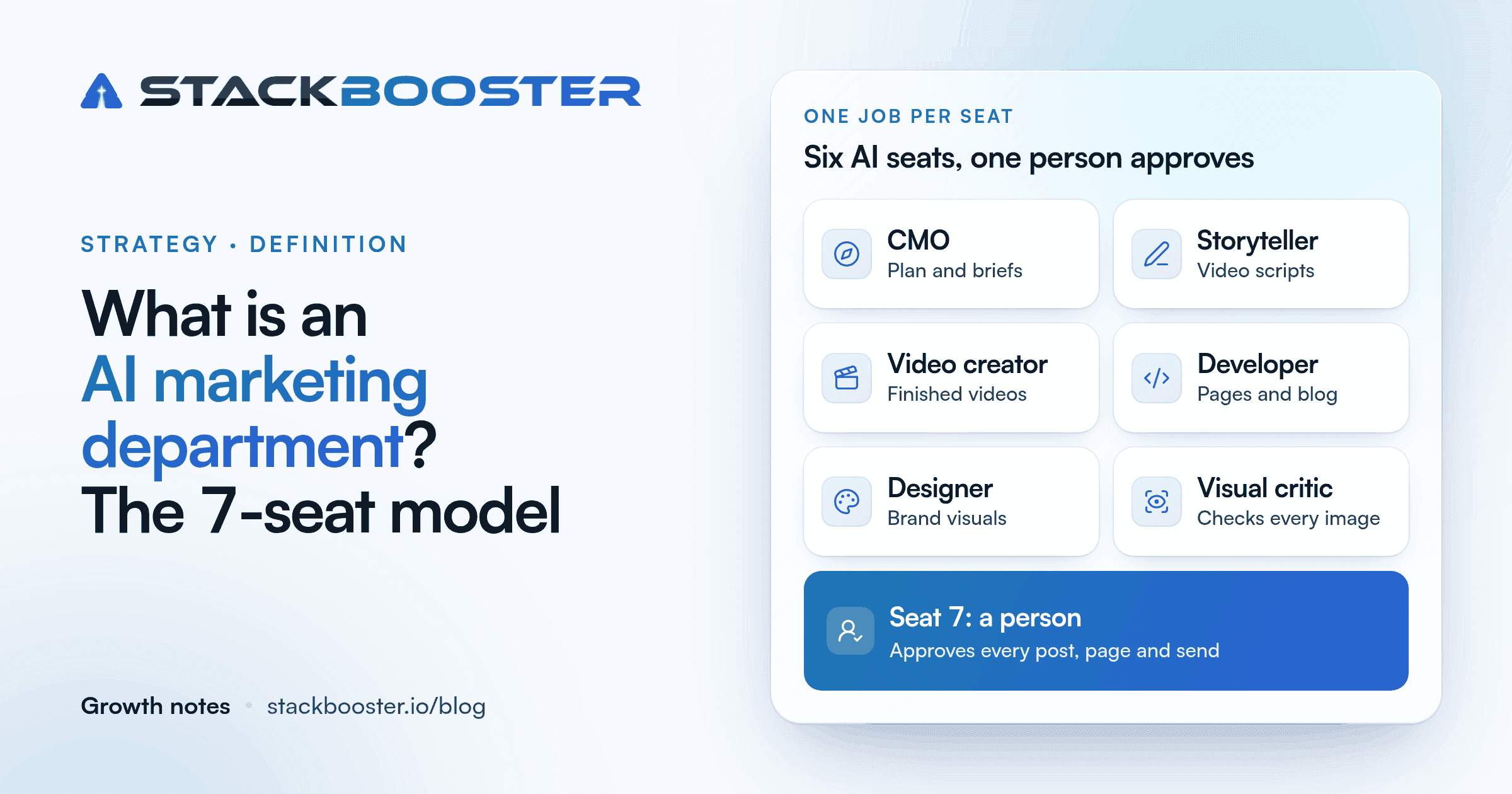
An AI marketing department is a set of AI agents, each with one job, that share one plan and one set of records. A person sets the goals and approves every external action. We run our own marketing on a 7-seat model: six AI seats and one human approver.
This guide shows the seven seats, how work moves between them, what still needs people and where to start.
An AI marketing department is a set of AI agents, each with one job, that share one plan and one set of records. A person sets the goals and approves every external action. We run our own marketing on a 7-seat model: six AI seats and one human approver.
Key takeaways
- An AI marketing department is defined by its roles and handoffs, not by the number of tools it uses.
- The 7-seat model has six AI seats (CMO, Storyteller, Video creator, Developer, Designer, Visual critic) and one person who approves.
- Each seat gets one brief, reads only the records that brief points to and hands back one checked result.
- Work moves in six steps: brief, draft, check, approve, publish, measure.
- Replies, decisions about what to change and collecting customer proof still need people.
- Start with the planning seat and the approver; every other seat depends on a brief.
What is an AI marketing department, and what is it not?
An AI marketing department is an operating model: defined roles, a shared plan, shared records and one path to approval. The agents are the staff. The records are the memory. The approver is the manager who signs off.
It is easier to see against the things it gets confused with:
- It is not a tool stack. Tools wait for a prompt and forget the context afterwards. A department gives every agent a job description and the same records, so a script, a page and a post all start from one brief.
- It is not an agency. An agency is people running your account on their process. A department runs on your plan and your records, and you approve each item yourself.
- It is not fully autonomous. Ours publishes nothing without a person's yes. That rule slows some things down. It also keeps claims accurate and the brand recognisable.
If you are weighing a department against an agency, a hire or DIY tools, our comparison of four options covers cost, speed and ownership.
What is the 7-seat model?
The 7-seat model is six AI seats with one job each, plus one person who approves. Every seat receives one brief, reads only the records that brief points to and hands back one result with a check attached.
| Seat | Job | Gets | Hands back | Who approves |
|---|---|---|---|---|
| 1. CMO | Strategy, weekly plan, briefs, articles, scoring results | Goals, records, last week's numbers | A plan, briefs, article drafts, a weekly readout | The approver |
| 2. Storyteller | Short video scripts | One brief, positioning, tone of voice | A script and a render spec | The approver (script and cost) |
| 3. Video creator | Turns an approved script into finished video | Approved script and budget | Video files and the actual cost | Visual critic, then the approver |
| 4. Developer | Puts articles and pages on the site; technical SEO | Approved article text | A preview link with checks passed | The approver says "publish" |
| 5. Designer | Images and carousels in the brand style | A visual brief | Image files | Visual critic, then the approver |
| 6. Visual critic | Checks every image and video before a person sees it | The file and its brief | A verdict with fixes | Feeds the approver |
| 7. Approver (a person) | Approves every post, page, video and send | A short digest of finished items | Yes, a change request, or skip | — |
The 7-seat model: six AI seats with one job each and one human approver. Seats 1–6 are AI agents; seat 7 is a person.
Two design choices make the model work. First, one job per seat: a seat that writes scripts does not also judge its own visuals. Second, one checker before the person: the approver's time goes to decisions, not to catching typos or off-brand colours.
How does work move through an AI marketing department?
Work moves in six steps, always in the same order. Each step has an owner and a written output, so anyone can see where an item is stuck.
- Brief. The CMO seat turns an idea into a brief: the angle, the reader, the problem, the proof, the call to action and the slot.
- Draft. The seat that owns the format produces it: a post, a script, an article or an image.
- Check. Text is checked against the claims the company may make and a list of AI writing tells. Images and video go to the visual critic.
- Approve. The person sees a short digest and approves items by their ID. Silence is not approval, and any edit after approval needs a new yes.
- Publish. The approved version goes out in its slot. The live link is checked and recorded.
- Measure. Numbers are pulled at 48 hours and 7 days. Once a week, results become a short readout, new learnings and three things to test next week.
The weekly loop matters more than any single seat. Without step 6, the department repeats its first guesses forever. Our guide to the seven touches of a marketing funnel explains why the measuring step is where most teams stop.
What does an AI marketing department still need people for?
An AI marketing department still needs people for judgment, relationships and proof. In our own setup, three jobs stay manual:
- Replying to comments and messages. Conversations with real buyers stay with people.
- Deciding what to change. The CMO seat drafts the weekly review and proposes tests. A person decides which ones to run.
- Collecting proof. Customer permissions and case studies need a human relationship. This is the slowest part of the whole system, and no agent can do it for you.
Approval is the fourth human job, and it is deliberate. Google says it rewards helpful, high-quality content whether a person or AI produced it, and treats AI used to manipulate rankings as spam (Google Search Central). A person reading every item before it goes out is the simplest way to stay on the right side of that line.
How many seats do you need to start?
You need two seats to start: the planning seat and the approver. Every other seat depends on a brief, so without the planner the rest have nothing to work from.
Add seats in this order as the volume grows:
- CMO seat + approver. Weekly plan, briefs, and the text formats you publish most.
- Checker. Once a person reviews more than a handful of items a week, a checker saves the most time.
- The production seat for your main channel. Video if short video drives your reach; design if carousels do; the developer seat if search traffic matters.
- The rest. Only when a channel proves it is worth the extra output.
Before any seat, write the records it will read: what you sell, who buys it, the problems they describe, what you are allowed to claim and how you sound. Agents with thin context produce generic work, however capable the model.
Common mistakes when building an AI marketing department
- Starting with tools instead of roles. Buying five tools gives you five inboxes, not a department.
- One agent for everything. An agent that plans, writes and checks its own work misses its own mistakes.
- No claims list. Without a written list of what the company may say, drafts drift into numbers and promises nobody signed off.
- Approval by silence. "No objection" is not a yes. Name the item and approve it.
- No weekly review. If nobody reads the numbers and changes something, the department never improves.
How does StackBooster use the 7-seat model?
StackBooster is an AI growth team. We run our own marketing on the 7-seat model described here, with our founder as the approver, and we review its numbers every week.
For clients, the same model plans, builds, launches, measures, learns and changes the work every week, across the funnel from the first ad to the follow-up with warm leads. Nothing goes out until you approve it. We charge one flat monthly fee, never a percentage of ad spend. We only take brands we can 3x, so the first step is an audit of your current funnel.
Questions and answers
What is an AI marketing department?
An AI marketing department is a group of AI agents, each with one marketing job, that work from one shared plan and one set of records. A person sets the goals and approves anything that goes out under the company's name.
Does an AI marketing department replace a marketing team?
No. It takes over repeatable execution such as drafting, formatting, checking and scheduling. People still set direction, approve external actions, reply to customers and decide what to change after reading the results.
How many AI agents does a marketing department need?
Fewer than most people expect. We run ours on six AI seats plus one human approver. A small team can start with two: a planning seat that writes briefs and a person who approves, then add production and checking seats as the volume grows.
What is the difference between an AI marketing department and AI marketing tools?
Tools wait for someone to prompt them and keep no shared memory between tasks. A department gives each agent a defined job, a brief format, the same records and a fixed path to approval, so the work connects from plan to result.
Who approves the work in an AI marketing department?
A named person. In our setup nothing is published, sent or boosted until that person approves the specific item by its ID. Any edit after approval needs a new approval.
How much does an AI marketing department cost?
It depends on how you build it: software, model usage and the time a person spends on briefs and approvals. If you buy it as a service, compare the full monthly cost with an agency or a hire for the same scope. StackBooster charges one flat monthly fee, never a percentage of ad spend.
How long does it take to set up?
The slow part is the records, not the agents: what you sell, who buys it, what you may claim and how you sound. Once those exist, briefs and drafts follow quickly. Plan the first weeks around building and correcting that shared context.
Sources
- Google Search Central, Google Search's guidance about AI-generated contentOpened 2026-11-03. Google says it rewards high-quality content whether a person or AI produced it; using AI to manipulate rankings breaks its spam policies.
- Google Search Central, Creating helpful, reliable, people-first contentOpened 2026-11-03. Recommends asking 'Who, How, and Why' about content, including being clear about how automation was used.
- Alex Sharabudinov on LinkedIn, the org chart we run our marketing onPublished 2026-10-29. First-hand description of the same seats and the manual work that remains.
Example figures use demo data, marked “Example”. Names in the stories are made up.