












AI marketing agency alternative: agency, hire, tools or AI team?
 StackBooster growth team 8 min read
Keep an agency if your next campaign needs expertise you cannot supply. Hire in-house if marketing needs a daily decision-maker beside your product and sales teams. Use DIY tools when you already have someone who can run them.
An AI growth team is worth considering when execution keeps slipping between the plan, the page and the follow-up. You still need time to explain the business and approve the work. StackBooster wrote this comparison and is one of the four options.
Choose the model that covers the missing work, then check what happens when you leave it.
An AI marketing agency alternative is a way to run marketing through an in-house hire, a DIY tool stack or an AI growth team instead of a conventional agency engagement. Choose by the work you need someone to own, the time you can give it and the specialist judgment it requires. Compare total cost, approval controls and what you can take with you when you leave.
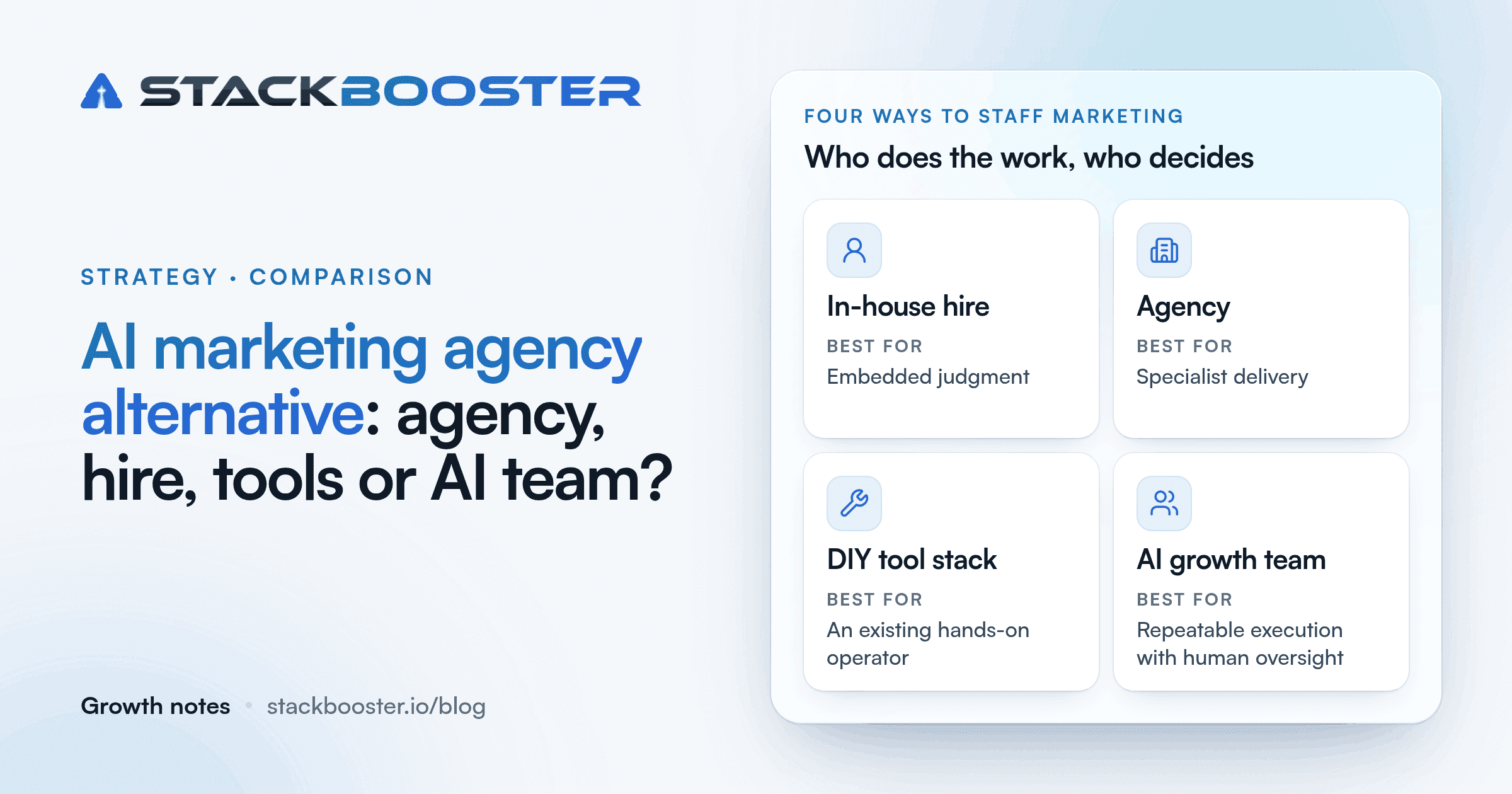
For a founder comparing proposals, that means looking beyond the monthly invoice. The table below compares operating models, followed by the questions to ask and a handover checklist you can use before switching.
Key takeaways
- An agency is a strong choice when a defined problem needs specialist expertise and a named delivery team.
- An in-house hire fits work that depends on daily access to product, sales and customer decisions.
- DIY tools fit an existing operator who can choose tests, connect systems and review the work.
- An AI growth team fits repeatable marketing execution when a person can supply context and approve external actions.
- Account access, creative rights and data portability are separate checks. Put each into the agreement.
- Compare the fee with setup, software, media spend and internal review time before deciding what costs less.
How does an AI marketing agency alternative compare?
The useful distinction is who does the work and who remains responsible for decisions. These are buying criteria, rather than measured rankings of every provider.
| Criterion | In-house hire | Agency | DIY tool stack | AI growth team |
|---|---|---|---|---|
| Time to start | Recruitment and onboarding if hiring anew | Availability, briefing and agreed scope | Account setup, connections and operator time | Onboarding and approvals; ask for a scoped launch plan |
| How you pay | Compensation, employment costs and tools | Agreed project or ongoing fee; inspect extras | Subscriptions or usage, plus your work | Provider-specific; StackBooster uses a flat monthly fee |
| Who owns accounts and data | Check company administration and employment terms | Check contract, account setup and export rights | Check vendor terms and exports separately | Check contract and exports; AI is no ownership promise |
| Who keeps test history | Require a shared company log | Make the log a handover deliverable | You maintain it | Require a readable, exportable log |
| Speed of learning | Depends on expertise and access to decisions | Depends on review cadence and scope | Depends on the operator's available time | Depends on evidence, review and approved changes |
| Control and approvals | You define authority | Specify approval points in the agreement | You configure and review each workflow | Verify controls; StackBooster requires approval before anything goes out |
| Main risk | One person's skill gaps and availability | Scope gaps or dependence on the delivery team | Founder becomes the integrator and reviewer | Fast output with weak context or unchecked mistakes |
| Best for | Embedded judgment | Specialist delivery | An existing hands-on operator | Repeatable execution with human oversight |
How we compared
We compared responsibilities, cost models and exit requirements, rather than testing providers against a shared benchmark. StackBooster is the AI growth team represented here, and this is our editorial judgment. Google permission documentation was checked on October 20, 2026. We have omitted agency prices, salary figures and unsupported claims about savings.
When is an in-house hire the better choice?
An in-house hire is the better choice when the missing work is daily judgment inside your business.
A marketer who joins product discussions can hear why a feature changed. They can speak to sales about objections and take those answers into the next campaign. That proximity matters when the offer changes frequently or several teams need to agree before anything launches.
Choose an in-house hire if someone needs to own marketing decisions every day.
The trade-off is breadth. A strong strategist may still need a designer, a technical analyst or a specialist media buyer. Write the role around the decisions you need them to make, then budget for the skills they will buy elsewhere.
Hiring also creates management work. Someone has to set priorities, judge performance and arrange cover. Before opening a role, list the recurring work and the decisions that currently wait for the founder. If the list is mostly a single production project, an agency may be the cleaner purchase.
When should you keep or choose an agency?
Choose an agency when a defined brief requires specialist experience or production capacity that your team lacks.
A complex brand launch, a filmed campaign or work requiring sector-specific review can justify a specialist team. Ask to meet the people doing the work. Their relevant experience matters more than whether the proposal describes them as AI-powered.
An agency wins on specialist depth when the actual delivery team has the expertise your brief requires.
A narrow scope can be useful. It gives you a deliverable to inspect and an owner to question. Trouble starts when you assume the agency also owns the landing page or lead follow-up, while its agreement covers only ads. Use the funnel guide to map those handoffs before signing.
Choose an agency if you can write a clear brief and name the expertise you are buying. Ask for examples of its review process, the revision allowance and a written exit plan. A capable agency that leaves you usable files and clear decisions may be worth keeping even if another option produces drafts faster.
When are DIY marketing tools enough?
DIY tools are enough when an existing operator knows what to test and has time to run the workflow.
You can pick a writing tool for drafts, a design tool for assets and a scheduler for publishing. That flexibility is valuable when the work is narrow. You can change one part without replacing the entire arrangement.
The cost you must count is your own work. Someone connects the form, checks where submissions go, reviews the copy and investigates missing data. Each extra tool adds another place to check when a handoff fails.
Choose DIY if you want direct control over tool choice and can reserve time to operate the stack.
DIY wins on that flexibility. It loses its appeal when the founder becomes the only person who understands the connections. Keep a workflow document with each tool's purpose, owner and export procedure. If maintaining that document is already beyond your available time, buying more subscriptions is unlikely to solve the staffing gap.
What does an AI growth team change?
An AI growth team is an option for delegating recurring execution while retaining human review.
For this comparison, the useful scope covers planning, building, launching, measuring and changing the work. Ask a prospective provider to walk through one complete task, including who approves it and how the result changes the next task. A collection of generated assets does not demonstrate that whole process.
Choose this model if you can supply business context but struggle to turn an agreed plan into reviewed work. Its strength is the opportunity to keep those recurring tasks in one workflow. The limitation is judgment: you must still verify facts and decide whether the proposed message fits your customers.
Use an AI growth team for execution you can inspect; retain specialist help for decisions you cannot evaluate.
For a regulated claim or an expensive original production, the specialist agency may remain the better choice. If daily internal alignment is the obstacle, hire the person who can resolve it. AI output cannot settle a disagreement about what the company should promise.
How should you compare cost, launch speed and learning?
Compare the same scope over the same period, including the work your team still has to do.
Ask each option to quote for the same campaign: the research, creative, page, measurement setup and review. Record setup charges, recurring fees, software and media spend separately. Add the hours your team expects to spend briefing, checking and coordinating. These are budgeting categories, not a claim that every provider charges for each one.
For an employee, include employment costs and outside support. For DIY, include integration and repair time. For an agency or AI team, request a written list of exclusions and the cost of changes.
A lower fee is meaningful only after the scope and remaining work match.
For speed, request two milestones: first reviewable work and first approved launch. Then ask what access or decisions could delay either. We cannot name a universal launch-speed winner from the evidence available here.
Learning needs a separate test. Ask each operator to show how it records a hypothesis, the evidence and the next decision. Choose a review date and one business outcome, such as qualified meetings or completed purchases. More drafts do not establish that a campaign improved. The learning winner is the option that can turn credible evidence into an approved change in your actual workflow.
What does StackBooster offer, and where are its limits?
StackBooster is an AI growth team: we plan, build, launch, measure, learn and change. We charge one flat monthly fee, never a percentage of ad spend. Nothing goes out until you approve it.
Our stated delivery timings are a first audit in about 1 hour and a full funnel live in about 12 hours, changed every week. These are StackBooster's claims, rather than independent comparative benchmarks. Ask us to define the scope and required inputs before using those timings in your plan.
StackBooster fits a founder who wants that execution loop and will review the work.
We would recommend a specialist agency for work requiring expertise or production beyond the agreed scope. We would recommend an in-house hire when you need a daily decision-maker embedded in your team. Data ownership, export rights and exit terms should still be checked in the agreement with us, just as with any other provider.
What should your agency handover checklist include?
Get the access, files and decision history your next operator needs before removing the agency's permissions.
Test the handover from your own company account while the outgoing team is still available.
- Confirm ad account IDs, company administrators, billing responsibility and linked agency accounts. Google's Ads access guide distinguishes reporting access from admin actions such as managing users and unlinking managers.
- Record pixels, meaning website tracking code, plus conversion events and tag settings. Identify who controls each and verify that intended events still arrive after the handover.
- Check analytics access. Google's Analytics permissions guide says an Editor cannot manage users; an Administrator can. Seeing reports is insufficient for managing the next team's access.
- Collect editable creative files, copy, page source files where contracted, and the relevant usage rights. Ask which fonts, footage or images need separate licences.
- Export the test history. Include the hypothesis, dates, audience, creative version, spend, result and reason for keeping or stopping each test. Ask for unresolved questions too.
- Inventory company-owned logins and recovery methods. Transfer access securely through individual permissions or a password manager. Do not request an employee's personal password.
- List scheduled posts, active campaigns and follow-ups. Name the person responsible for each during the changeover so work is neither duplicated nor abandoned.
- Have the new operator open the files, inspect account permissions and verify measurement. Then remove obsolete access and record the handover date.
This week, start with one campaign. Name its owner, its approval steps and the outcome you will review. Take that same brief to each option you are considering, and compare what each will deliver and what remains yours to do.
Questions and answers
What is an AI marketing agency alternative?
An AI marketing agency alternative is another operating model for marketing, such as an in-house hire, a DIY tool stack or an AI growth team. The right choice depends on who will set priorities, do the work, approve it and review results.
Can I replace my marketing agency with AI?
You can move suitable tasks to an AI-assisted workflow, but someone must still own strategy, factual review and approvals. Map what your agency does before switching. Keep specialist support for work that needs expertise you cannot supply internally.
When is a marketing agency better than an AI growth team?
Choose an agency when a defined project needs specialist judgment, substantial original production or sector-specific review. Check who will actually do the work and whether that expertise is included in the proposal.
When should I hire an in-house marketer?
Hire when marketing needs a daily decision-maker close to product, sales and customers, and you have enough ongoing work to support the role. Budget for software, management and outside specialists as well as compensation.
Is AI marketing cheaper than an agency?
There is no reliable category-wide answer. Compare written quotes for the same scope and include setup, software, media spend and internal review time. StackBooster charges one flat monthly fee, never a percentage of ad spend; that alone does not establish a cost advantage.
What should I get from my agency before switching?
Confirm access to ad accounts, analytics, pixels and conversion settings. Collect editable creative files with usage rights, test history, campaign settings and a list of scheduled work. Transfer company-owned logins securely and verify the new operator can work before removing old access.
Sources
- Google, About access levels in your Google Ads accountOpened 2026-10-20. Admin access includes managing users and unlinking manager accounts; reporting access alone is insufficient.
- Google, Access and data-restriction managementOpened 2026-10-20. Analytics Administrator can manage users; Editor cannot. Supports checking actual permissions during handover.
Example figures use demo data, marked “Example”. Names in the stories are made up.