












Marketing funnel for DTC brands: the seven-touch template
 StackBooster growth team 7 min read
Mint & Moss, a fictional home-fragrance brand, runs an ad for a candle that suits a small bedroom. People click. Orders stay flat.
The link opens a collection page. The shopper sees unfamiliar scent names, cannot find the candle from the video and leaves before learning the delivery cost.
The founder orders another ad. The next shopper gets the same page.
A DTC marketing funnel is the path from discovering a direct-to-consumer brand to buying, using the product and buying again. A practical marketing funnel for DTC brands gives every touch an asset, an owner and a measurable next action. The seven-touch template below is a planning tool, not a claim that every customer needs seven interactions.
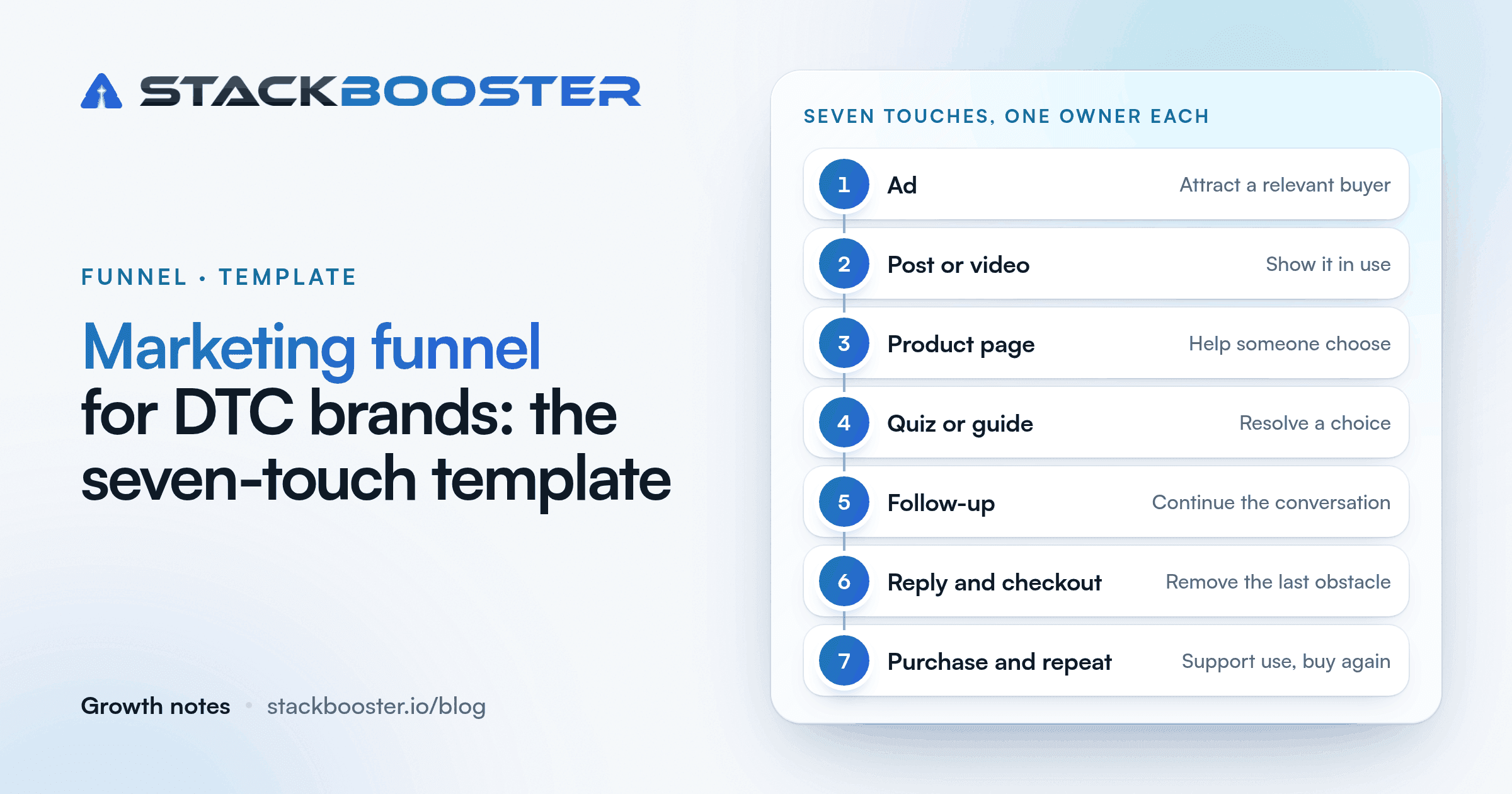
This DTC funnel example turns that problem into a worksheet: what each touch needs, who owns it and which number tells you where to look. Mint & Moss is a demo throughout, with no customer results implied.
For the broader framework, read our marketing funnel guide. Here, the job is to fill in your own ecommerce funnel template and choose the next repair.
Key takeaways
- Give each DTC touch a specific asset, a named owner and a next action you can measure.
- Check that the product, price and promise in the ad match the page before changing your advertising budget.
- A product quiz earns its place only when answers change the recommendation or the advice.
- Cart recovery needs eligibility checks and purchase suppression so buyers stop receiving reminders.
- Measure repeat purchases among customers with the same amount of time since their first order.
- Choose the first broken transition for your next test and record its result against a defined baseline.
What belongs in a marketing funnel for DTC brands?
A usable DTC funnel connects the promise that brought someone in with the help they need to choose, buy and use the product.
Seven touches are a planning checklist, not a required sequence for every shopper. Someone can buy straight from a product page. Another person may return through search, read reviews and ask about delivery. Keep a direct route to purchase available.
Use the table to audit coverage. Its metrics are diagnostic suggestions, not industry targets.
| Touch | Job | Mint & Moss asset | Metric to inspect | Typical leak |
|---|---|---|---|---|
| Ad | Attract a relevant buyer | Small-bedroom candle demonstration | Landing-page visits per outbound click | Click attracts curiosity unrelated to the offer |
| Post or video | Show the product in use | Room-size and scent demonstration | Product-page visits from tagged links | Attractive video never identifies the product |
| Product page | Help someone choose | Matching candle page with delivery and returns | Sessions adding to cart / product-page sessions | Promise or product differs from the ad |
| Quiz or guide | Resolve a choice | Optional room-and-scent selector | Result viewers who visit a product | Questions collect data without helping |
| Follow-up | Continue a permitted conversation | Scent guidance or cart reminder | Purchases among eligible recipients | Generic promotion ignores what they viewed |
| Reply and checkout | Remove the final obstacle | Delivery answer and working checkout | Completed checkouts / checkout starts | Question unanswered or payment fails |
| Purchase and repeat | Support use and return buying | Care instructions and relevant reorder reminder | Repeat buyers within a fixed follow-up period | Customer receives only another promotion |
A touch can contain several assets. Assign an owner even when an outside partner supplies them. The owner checks whether the next step works, including the links and events used to measure it.
How do you fill in the DTC funnel template?
Fill the template for a specific product and traffic source before mapping the rest of the store.
Copy these rows into a shared sheet. Replace brackets with actual names and links. For each metric, record the baseline dates and the denominator, meaning the group you divide by. Keep the proposed change in the final column until you have checked the evidence.
| Touch | Asset or destination | Accountable owner | Metric and baseline | Observed leak and next test |
|---|---|---|---|---|
| Ad | [Creative and landing URL] | [Name] | [Visits / outbound clicks; dates] | [Evidence; proposed change] |
| Post or video | [Content and product link] | [Name] | [Tagged visits; dates] | [Evidence; proposed change] |
| Product page | [Exact product URL] | [Name] | [Add-to-cart sessions / page sessions] | [Evidence; proposed change] |
| Quiz or guide | [Entry and result URLs, or skip] | [Name] | [Product visits / result viewers] | [Evidence; proposed change] |
| Follow-up | [Flow and eligibility rule] | [Name] | [Buyers / eligible recipients] | [Evidence; proposed change] |
| Reply and checkout | [Inbox and checkout test] | [Name] | [Purchases / checkout starts] | [Evidence; proposed change] |
| Purchase and repeat | [Care and reorder messages] | [Name] | [Repeat buyers / first-order group] | [Evidence; proposed change] |
An observation belongs before a proposed fix. For Mint & Moss, “the ad links to a collection” is observable. “Customers need a discount” remains a hypothesis.
Choose a reporting period and keep device and traffic source visible. Comparing mobile paid traffic with returning desktop shoppers can hide the actual problem. If the counts are small, record them as inconclusive rather than declaring a winner from a percentage alone.
Why am I getting clicks but no sales?
Clicks but no sales can mean the wrong visitors, a broken buying path or missing purchase tracking. Check each possibility before spending more.
Start by matching completed orders in your store to recorded purchase events. Then walk the same route as a shopper on a phone, beginning with the actual ad link.
- Check the offer. Does the page show the advertised product, price and availability? Can someone explain who it suits after reading the opening screen?
- Test page speed and usability. On a mobile connection, can you see the product and use the purchase button while images load? Check that pop-ups do not block it.
- Look for trust gaps. Show real product details, genuine reviews when available, delivery information and an accessible returns policy. Never invent proof to fill an empty page.
- Complete checkout. Test the intended delivery region and a supported payment method. Record unexpected charges, forced account creation, error messages and unavailable stock.
- Inspect follow-up. If an eligible shopper asks a question or leaves checkout, who handles the next step? Check whether the reply or reminder arrives and its link works.
Baymard's abandonment research identifies extra costs, delivery, trust and checkout problems among reported reasons for leaving. That makes them useful checks; it does not diagnose your store.
Repair the earliest confirmed failure before testing downstream persuasion. A coupon cannot repair a broken payment step. If the full route works, review whether the ad attracts people who want this product at this price.
When does a product quiz earn its place?
A quiz earns its place when a shopper's answers change the recommendation or explain how to choose.
For Mint & Moss, room size and scent preference could lead to different products. Show why each result fits, include a direct product link and let a shopper browse without completing the quiz. If every answer leads to the same candle, a short buying guide may do the job better.
Measure the whole route. Quiz completion can improve while purchases per visitor fall because you added work before checkout. Compare the quiz route with a direct product-page route using comparable traffic.
Collect only information you will use to help the shopper. Explain what an email signup includes and keep marketing permission clear. A quiz result should not require someone to agree to unrelated messages.
What should cart recovery and post-purchase follow-up do?
Cart recovery should help an eligible shopper finish a purchase; post-purchase follow-up should help a customer use what arrived.
Before the purchase
Separate product browsing, adding to cart and starting checkout. These events show different actions, and contact details or permission may be missing. Confirm which event your tool actually records before building a reminder around it.
Use the product context, answer a relevant question and include a tested checkout link. Suppress reminders after purchase or opt-out. Pause promotional follow-up when someone raises a support problem, and give the reply to a person.
A reported recovered checkout does not prove the email caused the purchase. Shopify's legacy recovery documentation explicitly includes customers who complete checkout on their own after the email was sent. Where feasible, compare an eligible group receiving the reminder with a comparable group held out of it.
After delivery
Send product-use advice when it becomes useful. Mint & Moss could provide candle-care instructions and a way to report a damaged delivery. A reorder reminder belongs near the likely replacement point, informed by actual purchase patterns rather than an arbitrary calendar date.
Measure repeat buying by cohort: customers grouped by their first purchase date. Give each cohort the same observation period. Otherwise, older customers have had more opportunity to reorder. Track refunds and unresolved support cases alongside repeat purchases.
How can StackBooster help with this work?
StackBooster is an AI growth team that plans, builds, launches, measures, learns and changes the work each week.
For a DTC founder using this worksheet, the useful starting point is a named product, its current buying path and the evidence behind the suspected leak. That gives the next review a concrete question to answer, such as whether a matching product page helps more visitors reach checkout.
Nothing goes out until you approve it. StackBooster works for one flat monthly fee, never a percentage of ad spend. Bring the completed worksheet when you apply so the conversation starts with the part of the funnel that needs attention.
What should you check this week?
Use this checklist to turn a suspected leak into a test with an owner and a result you can interpret.
- Choose a product and the traffic source you want to investigate.
- Fill every template row with an asset and an accountable person. Mark optional touches as skipped where appropriate.
- Verify purchase tracking against store orders before interpreting conversion rates.
- Walk the mobile buying path and capture the first failure with a screenshot or test order.
- Check follow-up eligibility, purchase suppression and who receives support replies.
- Write a test hypothesis that names the change, the metric and the baseline period. Set a review date before launch.
- Review purchase completion alongside refunds and repeat buying where enough time has passed. Log an inconclusive result when the evidence is too thin.
For Mint & Moss, the first test is the ad's destination. Keep the creative and offer unchanged, send comparable traffic to the matching candle page, and inspect add-to-cart sessions and completed purchases. Put the result in the worksheet before ordering another ad.
Questions and answers
How do you build a marketing funnel for a DTC brand?
Start with a product and a buyer need. Map the ad, supporting content, product page, optional quiz, follow-up, buying assistance and post-purchase experience. Give each touch an owner and a measurable next action, then test the first transition that fails.
What are the 5 stages of the marketing funnel?
A common DTC model uses awareness, consideration, conversion, retention and advocacy. Awareness introduces the brand; consideration helps buyers evaluate it; conversion is the purchase. Retention supports continued use and repeat buying, while advocacy covers reviews and referrals. Stage names vary between frameworks.
Why am I getting clicks but no sales?
Clicks can come from people who are curious but unlikely to buy. Other possible causes include a mismatched offer, a slow or confusing page, missing proof, unexpected delivery costs and checkout errors. Check your purchase tracking, then inspect where visitors stop before choosing a fix.
Does every DTC brand need a quiz funnel?
No. A quiz is useful when shoppers need help choosing between products and their answers change the recommendation. If a shopper already knows which product they want, a direct product page may be the better route. Test purchases per visitor alongside quiz completion.
What should an abandoned cart follow-up include?
Use the product context, a working return-to-checkout link and an answer to a likely buying question. Check contact eligibility and applicable consent rules before sending. Stop reminders after a purchase or opt-out, and handle support replies personally.
How should a DTC brand measure post-purchase retention?
Group customers by their first purchase date and compare repeat purchases over the same follow-up period. Choose a period that fits the product's expected use. Track refunds and support issues alongside repeat orders so you can see whether the product experience is improving.
Sources
- Baymard Institute, Cart Abandonment Rate Statistics, 2026Opened 2026-10-20. Supports delivery costs, trust, account creation, checkout complexity and errors as reported abandonment reasons. No numerical benchmark is reproduced.
- Shopify Help Center, Recovering abandoned checkoutsOpened 2026-10-20. Legacy-experience documentation supports checking payment events and distinguishing reported recovery from an email-caused purchase. No timing or platform-wide automation promise is inferred.
- Tribe Studio, The DTC Marketing Funnel: How It Works and Where Most Brands Get It WrongOpened 2026-10-20. Supports awareness, consideration, conversion, retention and advocacy as a common DTC framework. Its performance benchmarks are not used.
Example figures use demo data, marked “Example”. Names in the stories are made up.