












How to fix ad creative fatigue: a diagnostic worksheet
 StackBooster growth team 7 min read
Mint & Moss, a fictional home-care brand, opens its Monday report. Its cost per purchase has risen from $25 to $35. Example: that is a 40% increase, using invented figures for this worksheet.
The team asks for a new video. The existing ad still attracts visitors, but fewer shoppers finish checkout. Someone changed the delivery terms during the comparison period.
Replacing the video would leave the delivery problem untouched.
Ad fatigue is a decline in response caused by repeated exposure to the same creative. To work out how to fix ad creative fatigue, first check tracking, audience changes, the offer and the landing page. If the evidence points to the creative, test a distinct angle against the existing ad while keeping the offer and destination stable. Frequency alone cannot establish the cause.
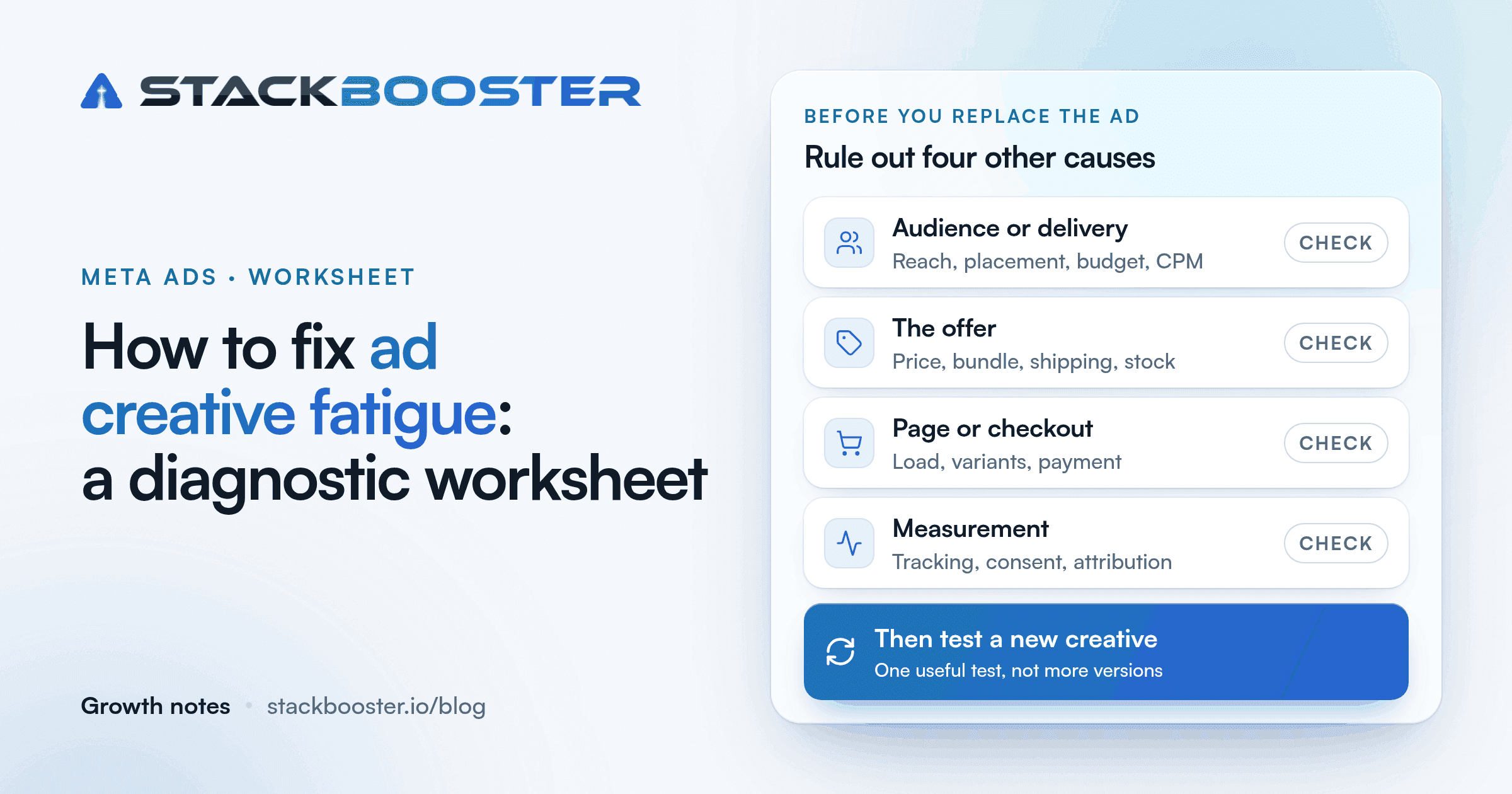
Before you commission another batch of ads, trace where performance changed. This worksheet separates a tired creative from problems with the audience, offer, landing page or measurement. It gives you a test to run even when the answer remains uncertain.
Key takeaways
- A rising cost per purchase is a reason to investigate, not proof that an ad has worn out.
- Check purchase tracking and the buying path before commissioning replacement ads.
- Meta's research distinguishes repeated exposure to a creative from broader audience saturation.
- Frequency is an average over a chosen period and can miss repeated creative across campaigns.
- Test a different reason to buy with distinct imagery, while holding the offer and destination stable.
- Judge the test on purchases and cost per purchase; a higher click-through rate alone cannot establish success.
What is ad creative fatigue, and what would prove it?
Creative fatigue is declining response from repeated exposure to the same creative. In its research on repeated exposures, published in May 2023, Meta distinguishes this from broader audience saturation, where people have had enough exposure to the brand and a creative refresh may fail to restore performance.
Meta also treats similar creative across different ads as relevant exposure. Duplicating an ad into another campaign does not give the person seeing it a new visual experience.
A rising cost per purchase does not establish the cause. It tells you that spend divided by recorded purchases has increased. Either side of that calculation deserves inspection.
For this worksheet, use CPA to mean cost per recorded purchase. Keep that definition consistent: a report counting leads cannot be compared directly with one counting purchases. A controlled creative test can strengthen a fatigue diagnosis, although a better new ad may also be a better idea regardless of repetition.
What else can look like creative fatigue?
Audience changes, a weaker offer, a broken buying path and measurement problems can all produce an apparent decline. Start with these checks because a creative refresh would leave their underlying causes in place.
Audience or delivery changed
Compare who the campaign reaches and where the ads appear. Separate prospecting, which reaches potential new buyers, from retargeting, which reaches people who already interacted. Check changes in geography, placement and budget alongside CPM, the cost of a thousand ad impressions.
Higher delivery costs with similar response rates suggest investigating delivery before blaming the creative. If every creative declines together, inspect shared causes. That pattern alone cannot identify which cause is responsible.
The offer became harder to accept
The offer includes the product, price, bundle and buying terms. Check whether a promotion ended, a popular option sold out or shipping became less attractive. Compare the terms shown in the ad with those at checkout.
An offer that never converted well has no established performance to recover. Interview buyers or inspect support questions before producing more versions of its headline.
The landing page or checkout changed
Open the ad link on a phone and complete the buying path. Look for a slow load, a broken variant selector, a missing discount or a payment failure. Compare the share of visits that reach checkout with the share of checkouts that become orders.
For the fictional Mint & Moss example, the delivery change makes checkout the first investigation. It remains a hypothesis until the team checks when abandonment changed and tests the terms.
Measurement changed
Compare store orders with recorded purchase events. Check recent changes to tracking, consent settings and attribution, meaning the rules that give an ad credit for a purchase. Allow comparable time for purchases to be reported.
Fix an identifiable measurement break before interpreting a creative test. Store totals are a cross-check, not a direct count of purchases caused by one campaign.
Which diagnostic question should you ask first?
Ask where the decline first appears, then use the pattern to select a test. The table gives investigation priorities rather than automatic diagnoses.
| Question | Where to look | What the pattern suggests | Next check |
|---|---|---|---|
| Did recorded purchases fall while store orders held? | Purchase events, store orders, reporting settings | Possible tracking or credit-assignment change | Trace a test order and recent tracking edits |
| Did visits hold while checkout completion fell? | Site funnel, delivery terms, payment flow | Offer or checkout friction | Complete the mobile purchase path |
| Did delivery become costlier across creatives? | CPM, placements, geography, budget history | A shared delivery or audience change | Compare like-for-like segments |
| Did established and new creatives both struggle? | Creative-level results and offer history | A shared offer, audience or page problem remains plausible | Inspect those shared conditions |
| Did an older creative lose response while a distinct one held? | Outbound clicks, purchases, exposure history | Creative fatigue is a stronger candidate | Run a controlled creative comparison |
Outbound CTR is the share of impressions that produce clicks away from the platform. Keep the same click definition throughout the comparison. A pattern chooses the next investigation; it does not close the case.
How should you use frequency when diagnosing fatigue?
Use frequency as supporting context rather than a replacement rule. Meta's research identifies two limitations: reported frequency sits at an ad, ad-set or campaign level, and its average can hide how often particular people have seen a creative.
A longer reporting window also changes what the average describes. Compare equivalent windows and inspect whether the same image or video runs elsewhere in the account.
This worksheet deliberately sets no universal frequency threshold. Record frequency beside the creative's history and purchase performance. A value by itself cannot tell you whether delivery terms changed or a checkout stopped working.
How do you fix ad creative fatigue with a useful test?
Test a distinct buying angle with visibly different creative after checking the shared causes. An angle is the reason a particular buyer should care. A new colour may be worth testing, but a product demonstration asks a more substantial question than a recoloured packaging image.
Meta's research reports experimental support for adding new creative to fatigued ad sets. It does not establish that every replacement will improve performance. Quality still matters.
Use this procedure:
- Define the symptom precisely. Write which creative declined, the comparison dates and the purchase metric affected. Include changes that could explain it.
- Choose a relevant objection. For Mint & Moss, an illustrative question is whether shoppers understand how to refill the bottle. Use actual reviews or support conversations to choose your own question.
- Build a distinct concept. Replace the packaging shot with a clear refill demonstration, provided that demonstration truthfully represents the product. Keep the product and buying terms unchanged.
- Compare against the existing ad. Use a controlled split test where practical, with comparable delivery conditions. Ordinary delivery can allocate spend unevenly, so its results deserve more cautious interpretation.
- Set the decision rule before launch. Name the spending limit, review date and purchase outcome you need. Base the observation period on your purchase volume and reporting delay. These are account-specific choices.
- Record the verdict and its limit. Keep, stop or inconclusive are all valid outcomes. If too few purchases arrive within the spending limit, record uncertainty instead of declaring a winner from clicks.
The test should change the creative concept while keeping the offer and destination stable. Changing a discount, page and video together may improve the campaign, but it leaves the creative question unresolved.
Which mistakes make the diagnosis harder?
Simultaneous edits, mismatched reporting windows and click-only verdicts make it harder to learn what changed. Save the original report and write down the exact intervention before you launch it.
A new hook can attract more curious visitors who never buy. Read purchase volume and cost per purchase beside CTR, then check whether cancellations or returns undermine the result. Avoid a claim that earns a click by creating an expectation the product cannot meet.
Keep a record of the offer shown with each creative. A creative tested during a promotion has a different context from the same creative tested after that promotion ends.
If the evidence points beyond the ad, map the rest of the path using the marketing funnel checklist. Leave healthy ads running within your agreed spending limits while you investigate the failing step.
How does StackBooster turn the diagnosis into weekly work?
StackBooster is an AI growth team: we plan, build, launch, measure, learn and change. For this problem, our recommended weekly review starts with the worksheet and ends with a written decision about the next test.
The review should connect the ad's promise to its destination and the buying terms. Its record names the suspected cause, evidence, owner and next review date. A weekly review does not require replacing a working ad every week.
Our Meta ads work belongs within that broader growth loop. We charge one flat monthly fee, never a percentage of ad spend. Nothing goes out until you approve it.
What should you check before replacing an ad this week?
Complete the worksheet and choose one test you can interpret. Keep the evidence beside the decision so the next review starts with what you learned.
- Define the purchase event and use comparable reporting windows.
- Check store orders against recorded purchases and recent tracking changes.
- Open the ad destination on a phone and complete checkout.
- Record changes to price, shipping, stock and promotions.
- Compare older and distinct newer creatives under similar conditions.
- Review delivery changes and repeated creative across campaigns.
- Write the suspected cause and what evidence would weaken it.
- Hold the offer and destination stable for a creative test.
- Set an account-specific spending limit and review date.
- Record purchases, cost per purchase and a keep, stop or inconclusive verdict.
Questions and answers
How do you fix ad creative fatigue?
Check that the performance decline is real, then compare tracking, audience, offer and landing-page changes. When the evidence points to creative fatigue, test a visibly different creative with a distinct buying angle against the existing ad. Keep the offer and destination stable and judge purchases as well as clicks.
What are the signs of Meta creative fatigue?
A previously effective creative losing response after repeated exposure is a fatigue candidate. Falling outbound click-through rate and rising cost per purchase can support that suspicion, but they also have other causes. Compare other creatives and check the buying path before deciding.
What frequency is too high for Meta ads?
This worksheet uses no universal frequency cutoff. Meta explains that frequency is an average over time and is reported at ad, ad-set or campaign level, while repeated exposure can span similar creatives across ads. Use it as context alongside performance and exposure patterns.
How can I tell ad fatigue from a weak offer?
An offer problem becomes more plausible when different creatives attract relevant visitors but purchases remain weak, especially after a price, bundle or shipping change. Creative fatigue becomes more plausible when an older creative declines while a distinct creative performs better under comparable conditions. Neither pattern proves the cause by itself.
Will changing an ad's colour fix creative fatigue?
A colour change can be tested, but it may leave the buying argument and most of the visual experience unchanged. For suspected fatigue, test a more distinct concept, such as a product demonstration replacing a packaging image. Keep the offer stable so the result is easier to interpret.
How often should I replace my ad creative?
Review performance regularly, but replace creative based on evidence rather than its age alone. Set the test duration around your purchase volume and conversion delay. A weekly review can end with a decision to keep running or to record an inconclusive result.
Sources
- Analytics at Meta, Creative Fatigue: How advertisers can improve performance by managing repeated exposures, May 10, 2023Accessed October 20, 2026. Supports the definition, distinction from audience saturation, frequency limitations and experimental evidence for adding differentiated creative. No numerical lift or universal exposure threshold is claimed here.
Example figures use demo data, marked “Example”. Names in the stories are made up.